


Getting a college acceptance letter is a great feeling. Shortly after, a new document arrives in the mail. This is your financial aid award letter.
At FAFS Info, we know these letters confuse many families. Colleges do not use one standard format. The layout changes from school to school. Some colleges even hide the real costs to make their campus look cheaper. We want to help you read the anatomy of an award letter correctly. This guide will show you how to compare offers side-by-side and find your true out-of-pocket price.
What is a Financial Aid Award Letter?
A financial aid award letter is an official document from a college. It tells you exactly how much money the school will give you to help pay for one academic year.
The school sends this letter after you apply and submit your Free Application for Federal Student Aid (FAFSA). You will use this letter to decide if you can afford to attend that specific college. Because the letters look different at every school, you must learn how to read the individual parts carefully.
The 5 Core Parts of Your Award Letter Explained
Most award letters break down your college costs and financial aid into five main sections.
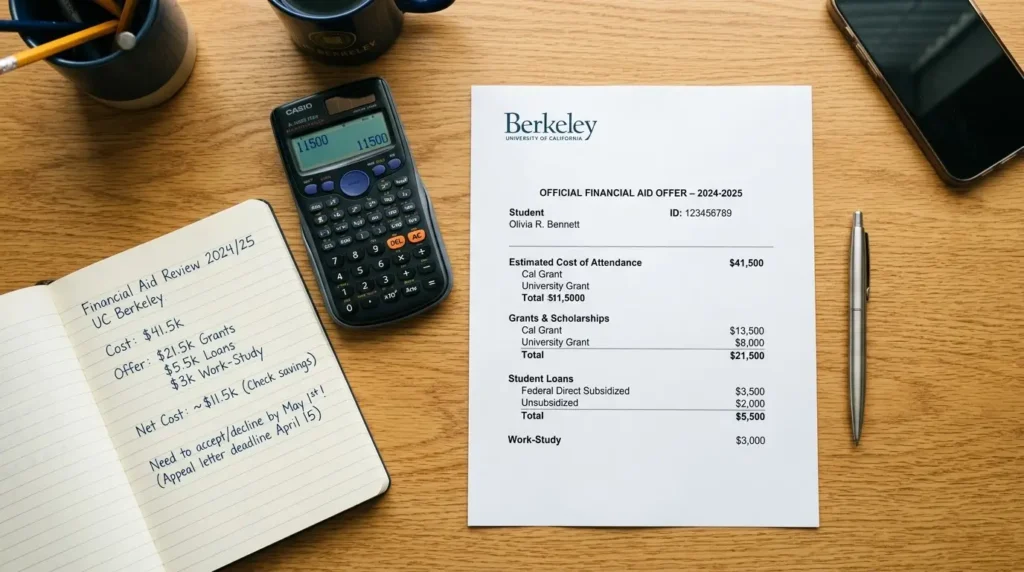
1. Cost of Attendance (COA)
The COA is the total yearly cost a college estimates. It will include an estimate of housing and meals even if you don’t live on campus. It is important to know that the COA is not a bill.
A complete Cost of Attendance includes:
-
Tuition and Fees
-
Housing and Meals
-
Books and Supplies
-
Transportation
-
Health Care
-
Personal Expenses
2. Student Aid Index (SAI)
The Student Aid Index is the amount the federal formula suggests a family can contribute toward the cost of college. This will appear only if you submit the FAFSA, and not all colleges include it on the award letter. The SAI helps the school figure out how much need-based aid you should receive.
3. Grants and Scholarships (Free Money!)
This is the best part of your offer. Grants and scholarships are aid that does not need to be repaid.
Common types include:
-
Merit Awards
-
Institutional Scholarships
-
Federal Pell Grants
-
State Grants
-
Need-Based Grants
If you need help qualifying for more need-based grants, read our guide on FAFSA independent student requirements 2026.
4. Loans
Loans are money that must be repaid with interest. You do not have to accept every loan the school offers.
Pay attention to these four loan types:
-
Direct Subsidized Loan: Interest does not accrue while you’re enrolled at least half-time.
-
Direct Unsubsidized Loan: Interest starts accruing immediately.
-
Parent PLUS Loan: Borrowed by parents and requires a credit check.
-
Private Loans: Offered by banks/lenders with varying interest rates and repayment terms.
5. Work-Study
Work-study is a part-time job, often on campus, that allows students to earn money to pay for their college expenses.
Here are the key notes you must remember about work-study:
-
Funds must be earned through working.
-
Students often need to apply or interview for individual work-study jobs.
-
Work-study funds are generally paid directly to the student as the dollars are earned. This money does not lower your tuition bill upfront.
The “Bear Traps”: Red Flags to Watch Out For

Colleges want you to attend their school. Sometimes, they format the award letter to make the school look more affordable than it really is. Watch out for these traps:
-
Missing Indirect Costs: If a school only lists tuition and dorm fees under the COA, the total cost will look low. You must add the cost of books, travel, and personal items yourself.
-
Hidden Special Notes and Conditions: Always read the fine print. Award letters may also include renewal requirements, instructions for accepting or declining awards, deadlines, housing estimates, and enrollment expectations. If you miss a deadline, you could lose your scholarships.
-
Parent PLUS Loans as “Aid”: Some colleges put large Parent PLUS loans in the financial aid section. This makes your remaining balance look like zero. However, your parents must pass a credit check to get this loan, and the interest rates are high.
How to Calculate Your True Net Price (With Examples)
The easiest way to compare different college offers is to find the net price.
The net price is the COA minus all grants and scholarships. This reflects the actual cost your family will need to cover with savings, income, loans, payment plans, etc..
Colleges may label it as:
-
Net Price
-
Out-of-Pocket Cost
-
Amount Due
-
Remaining Balance
Comparison Worksheet Example
| Category | University A | University B |
| Total Cost of Attendance (COA) | $40,000 | $25,000 |
| Minus Total Grants & Scholarships | -$20,000 | -$2,000 |
| Your True Net Price | $20,000 | $23,000 |
Even though University A has a much higher starting cost ($40,000), they gave you lots of free money. University A is actually cheaper for you in the end. Do this math for every school you apply to.
How to Appeal Your Financial Aid Offer

Sometimes, the financial aid offered is simply not enough. You have the right to ask the college for more money. This process is called an appeal.
You should write an appeal letter if:
-
A parent recently lost a job or took a pay cut.
-
Your family has high medical bills that the FAFSA did not catch.
-
Another similar college offered you a much better financial aid package.
Call the financial aid office. Explain your situation clearly. Provide documents to prove your change in income. The worst they can say is no.
7 Questions to Ask the Financial Aid Office
If anything on your award letter is confusing, do not guess. Call the school. Here are seven smart questions you can ask the financial aid office before you make a decision:
-
Are my grants and scholarships guaranteed for all four years?
-
What GPA must I maintain to keep my merit scholarships?
-
Will my institutional grants decrease if I win an outside scholarship?
-
Are the costs listed on the letter fixed, or do they increase every year?
-
How many hours per week do I need to work to earn my full work-study amount?
-
What is the average student loan debt for a graduate from this college?
-
How do I safely process my federal loans through official student loans websites?
Frequently Asked Questions (FAQs)
Do I have to accept all the student loans on my award letter?
No. You do not have to accept any loans if you do not want them. You can accept the grants and scholarships and reject the loans. You can also ask to borrow a smaller amount than what the school offered.
What happens if I do not earn all my work-study money?
Work-study is not guaranteed cash. If you choose not to get a campus job, or if you do not work enough hours, you simply will not get that money. You will have to cover your personal expenses another way.
Are Parent PLUS loans guaranteed?
No. Even if a Parent PLUS loan is on your award letter, your parents must still apply for it. They must pass a credit check to get approved by the government.
Will my financial aid package stay the same every year?
Not always. You must file the FAFSA every year. If your family income goes up, your need-based grants might go down. Also, if your grades drop, you could lose your merit scholarships.
What should I do if a college gives me a short deadline to accept?
Most colleges give you until May 1st to make a final decision. If a school pressures you to accept an offer earlier, politely contact the financial aid office. Ask them for an extension so you can compare all your other college offers fairly.