

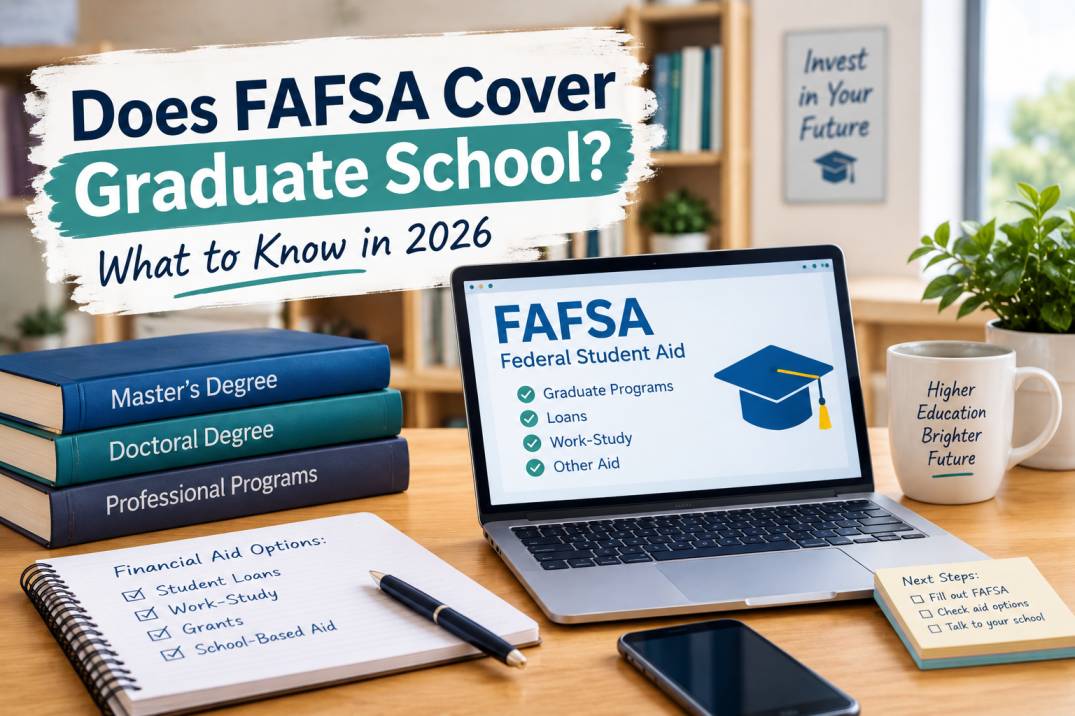
Yes, graduate students can use the Free Application for Federal Student Aid (FAFSA) to apply for financial aid for graduate school, including many master’s, doctoral, and professional degree programs. However, FAFSA does not mean the government will automatically pay your full tuition or other graduate school costs. Instead, your FAFSA information is used to determine which types of financial aid you may qualify for and how much assistance your school can offer.
For graduate students, that may include federal student loans, Federal Work-Study, and certain grants or school-based aid. The amount available can depend on your program’s cost of attendance and the type of aid involved, so the actual financial support can vary from one student and school to another. In the sections below, we’ll explain which aid options FAFSA can open up, how much they may contribute toward graduate school, and what has changed for graduate student loans in 2026.
Does FAFSA Cover Graduate School?
Yes, you can use the FAFSA for graduate school, including eligible master’s, doctoral, and professional degree programs. But filing the FAFSA does not mean FAFSA itself pays your tuition or guarantees enough aid to cover your full degree. It determines your potential eligibility for federal and other financial aid, while your school determines the final aid package based on your program costs and eligibility.
Source: Federal Student Aid.
Does FAFSA Cover Master’s Degree Programs?
A master’s degree can qualify for federal student aid through the FAFSA when the program and student meet the applicable requirements. Graduate students may be considered for options such as Direct Unsubsidized Loans, Federal Work-Study, and certain grants or school-based financial aid. The FAFSA opens the door to these opportunities, but the amount of assistance depends on the student’s eligibility and the school’s final aid package.
How Much of Graduate School Can FAFSA Cover?
FAFSA doesn’t cover the same amount for every graduate student. The financial aid available depends on factors such as the type of federal aid you qualify for, your school’s cost of attendance, your enrollment and program, and any other financial assistance included in your aid package. Your school uses this information to determine how much eligible aid you can receive, so one student may have a very different package from another.
What Does FAFSA Cover for Graduate Students?
FAFSA can connect graduate students with several types of financial aid, but each option works differently. The main possibilities include federal loans, work-study, and certain grants, while some common undergraduate aid is generally unavailable at the graduate level.
Federal Student Loans
For many graduate students, federal loans are the main form of FAFSA-related funding. A Direct Unsubsidized Loan can be used toward eligible education costs included in the school’s cost of attendance, such as tuition, fees, books, and certain living expenses. For graduate students in programs that are not classified as professional degrees, the 2026 annual limit is $20,500, subject to the applicable aggregate limits. Unlike a grant, this money must be repaid, and interest accrues while the loan is outstanding.
Federal Work-Study
Graduate students can also qualify for Federal Work-Study if their school participates in the program and they meet the eligibility requirements. Rather than receiving a lump sum toward tuition, students earn the money by working in an approved part-time position. The wages can help with education or living expenses, but the amount available depends on the school, funding, and the work-study award.
TEACH Grant
The TEACH Grant is available only to students who meet specific requirements, so it is not a general source of graduate-school funding. Eligible graduate students must generally be enrolled in a qualifying program and agree to complete the required teaching service. If the service conditions are not met, the grant can be converted into a loan that must be repaid, making the obligation an important part of the decision.
Can Graduate Students Get Pell Grants?
For a standard graduate program, Pell Grants are generally not available. The Pell Grant is primarily designed for eligible undergraduate students, so submitting a FAFSA does not automatically make a graduate student eligible for every federal aid program. Limited exceptions can apply to certain postbaccalaureate teacher-certification programs, but a typical master’s or doctoral student should not count on Pell Grant funding.
What Does FAFSA Not Cover for Graduate School?
What Does FAFSA Not Cover for Graduate School?
FAFSA can help you access graduate financial aid, but there are important limits on what that aid can provide. Graduate students generally cannot rely on the same grants or subsidized loans available to undergraduates, and federal aid cannot simply expand to cover every cost once applicable borrowing or cost-of-attendance limits are reached.
- Most federal grants: The Federal Pell Grant is generally not available for standard graduate programs, although limited exceptions can apply to certain teacher-certification programs.
- Subsidized federal loans: Graduate students generally cannot receive Direct Subsidized Loans. Direct Unsubsidized Loans accrue interest while you are in school.
- Costs above federal loan limits: If your eligible graduate expenses exceed the amount of federal aid you can borrow, FAFSA does not automatically provide additional funding to close the gap.
- The full cost of attendance is not guaranteed: Even when a school calculates a higher cost of attendance, that does not mean you will receive enough financial aid to cover the entire amount.
- Grad PLUS for new borrowers: Starting July 1, 2026, new graduate borrowers generally cannot use Grad PLUS Loans to finance costs beyond the standard federal graduate loan limits, subject to a limited exception for certain continuing borrowers.
How Does Cost of Attendance Affect FAFSA Aid for Graduate School?
Your school’s Cost of Attendance (COA) is an important part of determining how much financial aid you may receive for graduate school. It represents the estimated cost of attending the program for a specific period and can include more than tuition alone. Federal aid generally cannot exceed the school’s established cost of attendance when combined with other applicable financial assistance.
What Is Cost of Attendance?
Cost of Attendance is the school’s estimate of the expenses a student may have while enrolled in a graduate program. It typically combines direct education costs with reasonable allowances for necessary living and education-related expenses, giving the school a broader figure to use when determining the student’s overall financial need and aid eligibility.
Which Graduate School Expenses Can Be Included?
Depending on the school and program, the COA can account for several costs beyond tuition:
| Expense | Can be part of COA? |
| Tuition and required fees | Yes |
| Books and supplies | Yes |
| Housing | Yes |
| Food | Yes |
| Transportation | Yes |
| Other eligible education-related expenses | Depending on circumstances |
The exact COA can vary between schools because each institution establishes its own allowances within applicable federal requirements.
Does FAFSA Pay for Living Expenses?
FAFSA does not directly pay your rent, groceries, or other living bills. Instead, eligible financial aid can be applied toward the overall educational costs represented in your school’s COA. If your aid package leaves funds after charges such as tuition and required fees are covered, those funds may be available for other eligible expenses included in the COA, subject to the terms of the aid.
What Changed for Graduate Student Aid in 2026?
Graduate student borrowing rules changed significantly on July 1, 2026. The biggest change is the phaseout of Grad PLUS for new graduate borrowers, alongside new annual and aggregate limits for Direct Unsubsidized Loans. This means information published before 2026 may describe borrowing options that no longer apply to a new graduate student. 2026 Federal Student Aid Update: The U.S. Department of Education’s Federal Student Aid guidance confirms that Grad PLUS is no longer available to most new graduate and professional borrowers beginning July 1, 2026, while new annual and aggregate loan limits apply.
Are Grad PLUS Loans Still Available?
For most new graduate borrowers, Grad PLUS is no longer available beginning July 1, 2026. Before this change, eligible graduate students could use Grad PLUS to borrow up to their school’s cost of attendance after other financial aid was taken into account. That is why many older articles still describe Grad PLUS as an option for covering remaining graduate school costs.
There is a limited exception for certain students who were already enrolled in the same program at the same school before the new rules took effect and had borrowed a Direct Loan for that program before July 1, 2026, while continuing to meet the applicable enrollment requirements. For those students, the previous borrowing treatment can continue under the transition rules.
What Are the 2026 Federal Loan Limits?
For a graduate student in a program that is not classified as a professional degree, the 2026 Direct Unsubsidized Loan limit is $20,500 per year, with a $100,000 aggregate graduate borrowing limit for students who have never been professional. Different limits apply to professional students and to graduate students who previously borrowed as professional students.
| Student category | Annual Direct Unsubsidized limit | Aggregate limit |
| Graduate student | $20,500 | $100,000 |
| Professional student | $50,000 | $200,000* |
The professional-student aggregate limit is reduced by applicable prior graduate borrowing. A new $257,500 lifetime aggregate maximum also applies across graduate and professional borrowing.
This change matters when answering “how much does FAFSA cover for graduate school?” because FAFSA itself does not set a single coverage amount. For many new graduate students, the federal Direct Unsubsidized Loan limit is now a much clearer ceiling on how much federal loan funding they can access through this route.
How Is FAFSA Different for Graduate Students?
The FAFSA process is broadly the same, but graduate students are treated differently for federal aid purposes. The two differences that matter most here are independent student status and how financial information is considered when determining eligibility for different types of aid. Your FAFSA information is used as part of the federal aid process, while the Student Aid Index (SAI) is one of the figures used by schools when determining need-based aid.
Are Graduate Students Independent on FAFSA?
Graduate and professional students are generally considered independent students on the FAFSA. This means they normally do not need to provide their parents’ financial information when completing the form. Instead, the FAFSA is based on the student’s own financial information and circumstances.
This status can make the FAFSA simpler for graduate students who are no longer financially dependent on their parents, but it does not mean every graduate student automatically qualifies for more aid.
Does Income Matter for Graduate FAFSA?
Being classified as an independent student does not mean income becomes irrelevant. Different types of financial aid use different eligibility requirements, and schools may consider the student’s financial information when determining need-based aid.
For example, Direct Unsubsidized Loans do not require demonstrated financial need, while programs such as Federal Work-Study can involve financial-need considerations. The FAFSA therefore remains important even when parents’ income is not part of the application.
What If FAFSA Doesn’t Cover All of Graduate School?
FAFSA-based aid may leave a gap between your available financial aid and the total cost of your graduate program. When that happens, the next step is usually to look for funding tied specifically to your program, employer, or remaining education costs rather than assuming federal aid will cover the difference. If FAFSA-based aid does not cover the full cost, graduate students may need to consider other sources of funding. This is also relevant for students exploring financial aid options after graduation.
Scholarships and Fellowships
Graduate scholarships and fellowships can reduce the amount you need to pay or borrow. Unlike student loans, many do not require repayment, although fellowships can have specific academic, research, or program requirements. Your university and external organizations may offer opportunities specifically for graduate students.
Graduate Assistantships
A graduate assistantship can help close the funding gap through a combination of financial support and academic work. Depending on the program, an assistantship may provide a stipend, tuition assistance, or both in exchange for teaching, research, or other university responsibilities.
Employer Tuition Assistance
If you are working while pursuing your degree, your employer may offer tuition assistance or an education reimbursement benefit. The amount and eligible programs vary by employer, so this can be worth checking before taking additional student loans.
Private Student Loans
Private student loans can be considered when federal aid and other funding sources still do not cover the remaining eligible costs. However, they are separate from federal student aid and can have different interest rates, repayment terms, and borrower protections, so they should generally be evaluated after available federal and non-loan options.
How to Apply for FAFSA for Graduate School
Applying for FAFSA as a graduate student follows the same basic application process, but you should make sure the form matches the academic year and graduate program for which you are seeking aid.
- Complete the FAFSA for the correct academic year. Use the FAFSA form that corresponds to the year you plan to attend graduate school.
- Add your graduate school. Include the school or schools where you are applying or plan to enroll so they can receive your FAFSA information.
- Submit the required financial information. Provide the information requested on the form and complete any required sections before submitting it.
- Review your FAFSA Submission Summary. After processing, check the summary for your reported information and the federal aid eligibility information provided.
- Check your school’s financial aid offer and deadlines. Your school makes the final determination about the aid it can offer, so review its award details and respond by the required deadline.
For more guides on FAFSA eligibility, deadlines, and student aid, visit FAFSInfo.
Keep in mind: Your FAFSA Submission Summary is not the same as a final financial aid award. It provides information about your FAFSA and estimated eligibility, while the school determines your actual financial aid package.
How to Know If FAFSA Will Be Enough for Your Graduate School
The easiest way to see whether FAFSA-based aid will be enough is to compare your school’s actual Cost of Attendance (COA) with the financial aid included in your offer. FAFSA does not provide one fixed amount for every graduate student, so the remaining balance can only be determined after your school calculates your costs and available aid.
A simple way to estimate the gap is:
Cost of Attendance − Scholarships/Grants/Other Aid − Federal Aid = Remaining Amount
For example, if your school lists a $40,000 COA, you receive $8,000 in scholarships and grants, and your eligible federal aid totals $20,500, you would have $11,500 remaining to cover through other available funding or personal resources. The important point is to use the COA and financial aid offer provided by your school, rather than assuming that filing FAFSA means your graduate degree will be fully covered.
Frequently Asked Questions
Does FAFSA cover master’s programs?
FAFSA can be used by eligible students pursuing a master’s degree. Filing the FAFSA makes you eligible to be considered for applicable federal, state, and school-based financial aid, but it does not guarantee that your entire master’s program will be paid for. Your school determines the final aid package based on your eligibility and program costs.
How much does FAFSA cover for graduate school?
There is no single FAFSA amount for graduate school. For 2026, eligible graduate students who have never been professional can generally borrow up to $20,500 per year in Direct Unsubsidized Loans, with a $100,000 aggregate graduate limit. Other aid may be available, but the final amount depends on the student and school.
Can FAFSA pay for graduate school tuition?
FAFSA does not directly pay your graduate school tuition. Instead, it is the application used to determine eligibility for financial aid. If you receive federal loans, grants, work-study, or other aid through your school, that assistance can help cover eligible education costs, including tuition and required fees.
Does FAFSA cover living expenses for graduate students?
Financial aid can contribute toward eligible living expenses included in your school’s Cost of Attendance, such as housing, food, and transportation. However, FAFSA does not directly pay your rent or other personal bills. The way aid is applied and whether funds remain available for those expenses depends on your school’s financial aid package.
Can graduate students get Pell Grants?
Generally, no. Federal Pell Grants are primarily available to eligible undergraduate students, so standard master’s and doctoral students should not expect Pell Grant funding. Limited exceptions can apply to certain postbaccalaureate teacher-certification programs.
Do graduate students need their parents’ information for FAFSA?
Generally, no. Graduate and professional students are normally treated as independent students for FAFSA purposes, so their parents’ financial information is not typically required. This does not mean that income becomes irrelevant; different types of aid have different eligibility requirements.
Do I have to fill out FAFSA every year for graduate school?
Yes, if you want to be considered for federal student aid for each new academic year. FAFSA is completed for a specific award year, so a previous application does not automatically cover all future years of graduate school. You should submit the FAFSA for each year you want aid and meet the relevant federal, state, and school deadlines.